Affiliate Disclosure:Home Vacuum Zone is reader-supported. When you buy through links on our site, we may earn an affiliate commission at no additional cost to you. This does not influence our reviews or recommendations — we only recommend products we genuinely believe in.
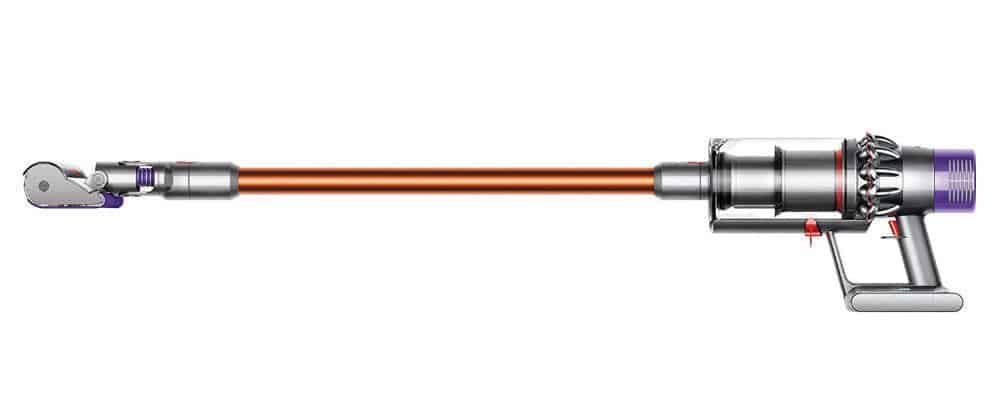
Dyson V10 Absolute (Refurbished/New)
The Dyson V10 remains a solid choice for budget-conscious buyers in 2026, but only if purchased at a significant discount. For full retail price, the V15 Detect or Gen5detect offer substantially better value with modern features and superior performance.
What We Like
- Excellent suction power with V10 Cyclone technology
- Lightweight and well-balanced design
- Proven long-term reliability since 2018 release
- Widely available replacement parts and accessories
- Great value when priced under $400
What We Don't
- No laser dust detection like V15 models
- Only 6 minutes runtime in Max power mode
- Trigger must be held continuously during use
- Battery not user-swappable without tools
- Outperformed by newer V11, V12, and V15 models
:::note[Editor’s Note – February 2026] The Dyson Cyclone V10 was originally released in March 2018, making it nearly 8 years old as of this 2026 update. This review examines the V10’s current market position, long-term reliability data from millions of units sold, and whether it remains a smart purchase compared to newer Dyson models and 2026 competitors. :::
Introduction: An Icon Approaching Its Tenth Anniversary
When James Dyson unveiled the Cyclone V10 in March 2018, he famously declared that Dyson would stop developing new corded vacuums entirely. That bold statement signaled a seismic shift in the industry - and for the most part, Dyson delivered on that promise. The V10 represented the culmination of everything Dyson had learned from the V6, V7, and V8 generations, packaged in a design that finally made cordless vacuums a genuine replacement for full-size corded machines.
Fast forward to 2026, and the cordless vacuum landscape has transformed dramatically. The V10 has been succeeded by the V11 (2019), V12 Detect (2021), V15 Detect (2021), and the flagship Gen5detect (2023). Each successor brought meaningful improvements: smarter sensors, laser dust detection, longer runtimes, and more powerful motors. Yet the V10 stubbornly refuses to fade into obsolescence, remaining widely available through Dyson’s official refurbished program and various retail channels.
This creates a genuine dilemma for shoppers in 2026. With new V10 Absolute models still retailing at a mid-range price point (though frequently discounted), and refurbished units available at even lower prices, the question isn’t whether the V10 is a good vacuum - it absolutely is. The question is whether it’s the right vacuum when the V15 Detect sits at a premium price point and competitors like the Shark Detect Pro and Tineco Pure One S15 offer compelling alternatives.
In this comprehensive 2026 review, we draw on nearly 8 years of accumulated user data, professional reviews, and long-term reliability reports to answer one simple question: Should you buy a Dyson V10 in 2026, or is it time to look elsewhere?
The V10’s Legacy: Why This Vacuum Mattered
To understand the V10’s current value, we need to appreciate what made it revolutionary in 2018. This wasn’t just an incremental upgrade - it was a fundamental redesign that established the template for every Dyson cordless vacuum that followed.
The Straight-Line Architecture
The most visible change from the V8 was the shift from a perpendicular dustbin to an inline, straight-line design. By aligning the motor, cyclone array, and dustbin horizontally, Dyson achieved several critical improvements:
- Enhanced airflow efficiency: The straight path reduced turbulence and air resistance, directly translating to better suction performance
- Improved bin emptying: The inline design enabled Dyson’s “point and shoot” bin emptying mechanism - still the industry standard in 2026
- Better weight distribution: The redesigned geometry made the V10 feel lighter and more balanced than its predecessors, despite actually weighing slightly more
The V10 Digital Motor: A Technical Marvel
At the heart of the V10 sits Dyson’s fourth-generation digital motor, spinning at an astonishing 125,000 RPM. To put that in perspective, that’s approximately 2,083 rotations per second - fast enough that the impeller tip speed approaches Mach 0.5. This 125,000 RPM figure remained Dyson’s benchmark until the Gen5detect’s 135,000 RPM motor in 2023.
The motor’s ceramic shaft, positioned at the center of the impeller rather than at the ends, eliminated the need for conventional bearings and reduced vibration. Dyson claimed this design would extend motor life to 15 years - and based on 2026 reliability data, that prediction appears accurate. Failure rates for V10 motors remain remarkably low even after 5-7 years of use.
The 14-Cyclone Array
Dyson’s cyclone technology separates dust and debris from airflow using centrifugal force. The V10 features 14 cyclones arranged in two tiers, generating forces exceeding 79,000 G. This multi-cyclone design ensures that even microscopic particles (down to 0.3 microns) are captured in the bin rather than clogging filters or returning to your home’s air.
The V10’s filtration system continues to meet HEPA standards, capturing 99.97% of allergens according to Dyson’s specifications - an important consideration for allergy sufferers choosing a vacuum. This is one area where the V10 genuinely hasn’t aged - the fundamental physics of cyclonic separation haven’t changed, and the V10’s system remains as effective as newer models.
Dyson V10 Models: Absolute vs. Animal vs. Motorhead
One area of persistent confusion is the differences between V10 variants. Dyson has used consistent naming conventions across generations, and understanding these distinctions is crucial for making an informed purchase in 2026.
Dyson V10 Absolute
The flagship configuration includes:
- Torque Drive cleaner head: Motorized brush bar for carpets with automatic resistance detection
- Soft roller cleaner head: Fluffy head with woven nylon and anti-static carbon fiber for hard floors
- Mini motorized tool: Powered brush for upholstery and stairs
- Combination tool: 2-in-1 brush and wide nozzle
- Crevice tool: Extended nozzle for tight spaces
- Dusting brush: Soft bristles for delicate surfaces
- Flexi crevice tool: Extendable, flexible wand for awkward angles
- Up-top adaptor: Angled adapter for high cleaning
- Extension hose: Flexible hose for reaching
- Wand clip: Storage for accessories on the wand
Dyson V10 Animal
The mid-tier option (typically somewhat less than the Absolute) includes:
- Torque Drive cleaner head (same as Absolute)
- Mini motorized tool
- Combination tool
- Crevice tool
- Dusting brush
Notably missing: The Soft roller cleaner head, flexi crevice tool, up-top adaptor, and extension hose. For homes with primarily carpeted floors, the Animal represents solid value. However, the absence of the fluffy head significantly compromises hard floor performance.
Dyson V10 Motorhead
The entry-level configuration includes:
- Direct drive cleaner head: Simpler motorized head (not the Torque Drive)
- Combination tool
- Crevice tool
This variant is significantly stripped down and generally not recommended unless found at a substantial discount. The Direct drive head lacks the automatic resistance adjustment of the Torque Drive, and the missing tools limit versatility.
2026 Availability Reality
As of February 2026, Dyson has officially discontinued new production of the V10 in most markets. However, the vacuum remains widely available through:
- Dyson Official Refurbished: Certified refurbished units with 1-2 year warranties
- Retail clearance: Remaining new stock at major retailers
- Third-party refurbished: Various sellers on Amazon, eBay, and specialty sites
Our recommendation: Only consider the Absolute or Animal variants in 2026. The Motorhead’s compromises don’t justify the minimal savings, and replacement tools are expensive to purchase separately.
Detailed Performance Analysis
To evaluate the V10’s current competitiveness, here’s how its specifications and real-world user feedback stack up against 2026 benchmarks.
Suction Power: Still Impressive
The V10 delivers 151 Air Watts (AW) of suction in Max mode - comparable to many full-size corded vacuums from the 2010s. While newer Dyson models have pushed this figure higher (the V15 reaches 240 AW, Gen5detect hits 262 AW), raw suction only tells part of the story.
Based on user reviews and professional evaluations:
- Carpet deep clean: The V10’s Torque Drive head effectively lifts embedded pet hair and fine debris from medium-pile carpet in a single pass
- Hard surface pickup: With the Soft roller head, the V10 excels on hardwood, tile, and laminate - arguably its strongest performance area
- Edge cleaning: The Torque Drive’s brush bar extends to the edge, capturing debris close to baseboards
- Large debris: Users report the V10 can struggle with larger items (cereal, leaves) in Max mode - the high suction can cause clogging at the cleaner head inlet
Runtime Reality Check
Dyson advertises up to 60 minutes of runtime, but this requires specific conditions that rarely align with real-world use:
| Mode | Suction Power | Actual Runtime (Non-Motorized Tool) | Runtime with Torque Drive Head |
|---|---|---|---|
| Suction Mode 1 (Eco) | ~15 AW | ~55-60 minutes | ~45-50 minutes |
| Suction Mode 2 (Medium) | ~33 AW | ~25-30 minutes | ~20-25 minutes |
| Max Mode | 151 AW | ~6-7 minutes | ~5-6 minutes |
The 6-minute Max mode runtime remains the V10’s most significant limitation. For whole-house deep cleaning, you’ll need to charge between rooms or accept longer cleaning sessions spread over multiple days. The lack of swappable batteries (without disassembly) compounds this issue.
The Trigger Hold Problem
One divisive design choice Dyson maintained through the V10 generation is the trigger-style power switch. Unlike the V11 and newer models that added continuous run modes, the V10 requires constant trigger pressure. Users commonly report:
- Hand fatigue: Sets in after 10-15 minutes of continuous use
- Workaround: Some users employ rubber bands or third-party trigger locks (voiding warranty)
- Battery preservation: The trigger design does prevent accidental battery drain
If you have arthritis, carpal tunnel, or simply prefer one-handed operation while moving furniture, this is a genuine consideration favoring newer Dyson models or competitors. If battery concerns are a dealbreaker, learn more about why your Dyson may not be holding its charge.
Noise Levels
Typical noise levels reported by independent reviewers:
- Mode 1: ~72-73 dB (comparable to normal conversation)
- Mode 2: ~78-80 dB (vacuum cleaner standard)
- Max Mode: ~83-84 dB (approaching the OSHA threshold for hearing protection during extended exposure)
The V10 is neither notably quiet nor objectionably loud by 2026 standards. Newer models with improved motor dampening (particularly the Gen5detect) operate more quietly, but the difference isn’t dramatic.
V10 vs. Newer Dyson Models: The Upgrade Question
For shoppers considering whether to buy a V10 in 2026 or invest in newer technology, here’s the direct comparison:
V10 vs. V11 Torque Drive
For a deeper dive into all three generations, see our full Dyson V11 vs V10 vs V8 comparison. The V11, released in 2019, represents the most direct comparison. Key differences:
- LCD screen: The V11 adds a small display showing remaining runtime (calculated in real-time), current mode, and maintenance alerts
- Auto mode: The V11’s Torque Drive head has integrated sensors that automatically adjust suction based on floor type
- Larger bin: 0.77L vs. 0.54L (40% more capacity)
- Runtime: The V11 extends runtime to approximately 20% longer in comparable modes
Verdict: The V11 is a refined V10. If you can find a V11 for a similar price to a V10, choose the V11. Otherwise, the differences aren’t transformative.
V10 vs. V15 Detect
The V15 Detect (2021) represents a more significant generational leap:
- Laser dust detection: A green laser on the cleaner head illuminates microscopic dust invisible to the naked eye - genuinely useful on hard floors
- Piezo sensor: Counts and measures dust particles, displaying results on the LCD
- Anti-tangle technology: The V15’s brush bar actively prevents hair wrap - major advantage for pet owners
- Power: 240 AW vs. 151 AW (52% more suction)
- Swappable battery: The V15’s battery can be removed and replaced without tools
Verdict: The V15 Detect outperforms the V10 in every measurable category. In 2026, with V15 prices frequently dipping during sales, the V10 only makes sense if found at a significant discount.
V10 vs. Gen5detect
Dyson’s current flagship (2023-present) exists in a different category entirely:
- Gen5 motor: 135,000 RPM with “Hyperdymium” technology
- 262 AW suction: 73% more powerful than the V10
- HEPA filtration: Whole-machine HEPA certification (the V10 captures allergens but isn’t certified HEPA)
- Fluffy Optic head: Improved laser system with wider beam
- Runtime: Up to 70 minutes with swappable battery option
Verdict: The Gen5detect is objectively superior in every way - but as a high-end flagship, it costs 2-3x what you’ll pay for a refurbished V10. This isn’t a direct competitor; it’s a different product category for different budgets.
2026 Market Position: Pricing, Reliability, and Parts
Current Pricing Landscape (February 2026)
Based on market analysis across major retailers:
| Source | V10 Absolute | V10 Animal | V10 Motorhead |
|---|---|---|---|
| Dyson Refurbished Official | Mid-range | Budget-friendly | Most affordable |
| Amazon (New/Third-party) | Mid-range | Mid-range | Budget-friendly |
| Retail Clearance (New) | Upper mid-range | Mid-range | Mid-range |
| Best Buy / Target | Mid-range | Mid-range | Budget-friendly |
Value Assessment: The V10 is only a good value when found at a significant discount. At near-V15 prices, it’s poor value since the V15 offers substantially more.
Long-Term Reliability: 5-8 Year Data
With millions of V10 units in service since 2018, we have excellent long-term reliability data:
Common Issues (by frequency):
- Battery degradation: After 3-4 years of regular use, expect 20-30% capacity loss. Replacement batteries are a moderate expense.
- Filter clogging: Washable filters require monthly cleaning; replacement filters needed every 12-18 months with heavy use.
- Brush bar motor failure: The mini motorized tool has a higher failure rate than the main cleaner head.
- Trigger switch failure: Rare but reported after 4+ years of heavy use.
Motor reliability: Exceptional. V10 motor failures are extremely rare even after 6+ years.
Overall assessment: The V10 has proven more reliable than the V6/V7 generations, with most components designed for 5-7 year service life.
Parts and Support Availability
Dyson continues to support the V10 with:
- Full replacement parts catalog available
- Battery replacements readily stocked
- Filter and brush bar replacements common
- Repair guides and service centers
As of 2026, no end-of-life has been announced for V10 parts support. Given the massive installed base, expect availability for at least another 3-5 years.
Competitor Comparison: 2026 Alternatives
The cordless vacuum market has evolved significantly since 2018. Here are the V10’s primary 2026 competitors:
Shark Detect Pro (IW3511)
Price: Mid-range (comparable to V10)
Advantages over V10:
- Auto-empty base station (select models)
- Better hair-wrap resistance
- Continuous run button (no trigger hold)
- Often includes extra batteries
Disadvantages:
- Heavier and less maneuverable
- Inferior hard floor performance
- Shorter overall runtime
Verdict: The Shark is a better choice for carpet-heavy homes and those wanting auto-empty convenience. The V10 maintains an edge on hard floors and overall build quality.
Tineco Pure One S15
Price: Mid-range (similar to V10)
Advantages over V10:
- Smart sensor adjusts suction automatically
- App integration with usage statistics
- Swappable battery design
- Generally quieter operation
Disadvantages:
- Less suction power (120 AW vs. 151 AW)
- Smaller dustbin
- Shorter track record for reliability
Verdict: The Tineco offers more modern features at a similar price, but the V10’s raw performance and proven longevity give it an edge for buyers prioritizing suction and durability.
Samsung Bespoke Jet
Price: Upper mid-range to premium
Advantages over V10:
- All-in-one clean station (auto-empty and charging)
- Sleek design
- Good suction (up to 210 AW)
- HEPA filtration
Disadvantages:
- Higher price point
- Bulkier when docked
- Replacement bags add ongoing cost
Verdict: The Samsung’s clean station is compelling, but as a premium-priced option compared to a refurbished V10, it’s a different budget category.
Who Should Buy a Dyson V10 in 2026?
After thorough analysis of specifications, user reviews, and market positioning, here’s our guidance:
✅ Buy the V10 If:
- You find it at a significant discount (Absolute or Animal variants only)
- Your home is primarily hard floors with some area rugs
- You want proven reliability over cutting-edge features
- You don’t mind the trigger hold or have workarounds
- You’re upgrading from a V7 or older and want meaningful improvement without flagship prices
- You appreciate Dyson’s build quality and engineering
❌ Skip the V10 If:
- The price approaches V15 territory (V15 is better value at that point)
- You have significant carpet and want anti-tangle technology
- You need whole-house cleaning in one session (battery limitations)
- Hand or wrist issues make trigger hold problematic
- You want laser dust detection or smart features
- You can stretch to a premium price point for a V15 Detect (significantly better investment)
Further Reading
- Shark APEX DuoClean Powered Lift-Away Review (2026): Current Models & Worth Buying?
- Bissell Powerforce Helix Review 2026 – Best Budget Upright Vacuum?
- Miele Triflex HX1 Review (2026): The Premium Cordless Vacuum Tested
- Where Are Dyson Vacuums Made? Manufacturing & Quality Explained
Final Verdict: The V10 in 2026
The Dyson Cyclone V10 remains a very good vacuum cleaner in 2026. Its 151 AW of suction, excellent filtration, and refined design have aged remarkably well. For hard floor cleaning especially, it remains competitive with vacuums costing twice as much.
However, we must be clear: the V10 is a legacy product. It lacks the smart features, extended runtime, and user-friendly touches (continuous run button, swappable battery) that define the 2026 cordless vacuum market. When Dyson released the V10 in 2018, it was revolutionary. In 2026, it’s merely competent.
Our recommendation: The V10 is worth buying in 2026 only at the right price. A well-discounted Absolute or Animal variant represents solid value. At prices approaching the V15’s range, the math doesn’t work - the V15 Detect and even some 2026 competitors offer substantially more for similar money.
For Dyson loyalists, the V10 serves as an excellent “second vacuum” for upstairs, workshops, or vacation homes. For first-time Dyson buyers, it’s a reasonable entry point to understand the brand’s engineering philosophy before potentially upgrading to newer models.
The V10 isn’t the future of cordless vacuums anymore. But nearly eight years after its release, it remains a capable, reliable cleaning tool that delivers genuine Dyson performance at a fraction of flagship prices. For the right buyer at the right price, that’s still a winning combination.
Also Consider
Dyson V10 Absolute
Medium homes wanting more capacity without premium priceThe V10 Absolute hits the sweet spot with 60 minutes of runtime, a 0.77L bin, and whole-machine HEPA filtration at a significantly lower price than the V15 or Gen5detect. Best for mid-size homes wanting proven Dyson performance without paying for laser detection or piezo sensors they may not need.
What We Like
- Larger 0.77L bin vs V8's 0.54L capacity
- Point-and-shoot hygienic bin emptying
- 60-minute max runtime in Eco mode
- Improved acoustic design reduces noise
- Whole-machine HEPA filtration
What We Don't
- Heavier than V8 at 5.9 lbs
- No automatic suction adjustment
- Motorhead variant less powerful than V11 models
- Trigger-hold operation can cause hand fatigue
Dyson V10 Animal
Mid-range DysonThe V10 Animal offers 151 AW of suction with a 60-minute runtime and a Torque Drive cleaner head that deep-cleans carpets effectively despite lacking the newer laser detection features. Best for pet owners who want proven Dyson reliability and strong carpet performance at a mid-range price point.
What We Like
- Powerful 151 AW suction
- 60 minute runtime in Eco mode
- Torque Drive cleaner head for deep cleaning
- Proven reliability and durability
What We Don't
- No laser dust detection technology
- Higher price point
- Heavier than some competitors at 5.88 lbs
Dyson V11 Torque Drive
Tech lovers and larger homes with mixed flooringThe Dyson V11 Torque Drive brings intelligent suction optimization and an LCD display to cordless cleaning, automatically adjusting power between carpets and hard floors. A strong choice for larger homes with mixed flooring who want set-and-forget performance without stepping up to the V15's price.
What We Like
- Intelligent Dynamic Load Sensor optimizes suction automatically
- LCD screen displays real-time performance data
- High Torque cleaner head auto-adjusts to floor type
- Up to 60 minutes runtime with intelligent power management
What We Don't
- Heaviest cordless Dyson at 6.68 lbs - noticeable during extended overhead cleaning
- 4.5-hour charge time for a full battery refill
- Trigger must be held continuously during use (no lock-on switch)
Dyson V15 Detect
Best cordless vacuumThe most technologically advanced cordless vacuum available, with genuine innovations in dust detection and suction optimization. Best for tech-forward buyers with mostly hard floors.
What We Like
- Laser reveals microscopic dust on hard floors
- Piezo sensor counts particles and displays in real-time
- Anti-tangle Motorbar cleaner head prevents hair wrap
- Powerful 240 AW suction with auto-adjusting power
What We Don't
- 60-minute runtime only in Eco mode (8 min in Boost)
- Small 0.2-gallon dustbin requires frequent emptying
- Premium price point
- 4.5-hour charging time is lengthy
Dyson Gen5detect
Best Dyson overallThe Gen5detect represents Dyson's most advanced cordless vacuum with 262 AW suction, a piezo sensor that counts particles in real time, and a Fluffy Optic laser head that reveals microscopic dust. Best for cleaning enthusiasts and allergy sufferers who want the absolute best suction, filtration, and runtime in a cordless format.
What We Like
- Latest generation Hyperdymium motor with 262 AW suction
- Advanced HEPA filtration captures 99.99% of particles
- 70-minute runtime in Eco mode
- Fluffy Optic cleaner head reveals microscopic dust
- Built-in dust particle counter and LCD screen
What We Don't
- Very expensive at premium price point
- Overkill for basic cleaning needs
- Heavy compared to competitor cordless models
Tineco Pure One S15 PRO
Best smart featuresThe Tineco Pure One S15 PRO features an iLoop smart sensor that automatically adjusts suction based on real-time dirt detection, paired with app-connected cleaning reports and a ZeroTangle brushroll. Best for tech-forward households that want data-driven cleaning optimization and automatic power management to maximize battery life.
What We Like
- Smart iLoop sensor adjusts suction automatically for battery efficiency
- App connectivity provides cleaning reports and maintenance alerts
- Up to 60 minutes runtime in eco mode
- LED display shows real-time dirt detection
- 4-stage HEPA filtration captures allergens
What We Don't
- App requires setup and smartphone connectivity
- 0.6L dustbin is smaller than some competitors
- Higher price point compared to non-smart models
Samsung Bespoke Jet
Best self-emptyingThe Samsung Bespoke Jet combines 210 AW suction with a 5-layer HEPA filtration system and an all-in-one clean station that auto-empties, charges, and stores the vacuum in a single unit. Best suited for design-conscious households that want a premium cordless vacuum with minimal maintenance.
What We Like
- All-in-one clean station with automatic dust emptying
- Self-emptying and charging dock included
- Sleek, modern design with multiple color options
- Strong suction with Jet Cyclone technology
- 5-layer HEPA filtration system
What We Don't
- Premium pricing significantly higher than competitors
- Clean station requires considerable floor space
- Heavier than some stick vacuum alternatives
Sources & Research
- Amazon Product Page
- Dyson V10 Overview
- Dyson Support Page
- Amazon Product Page
- Amazon Product Page
- Dyson Official
- Dyson Official Page
- Amazon Product Page
- Dyson Official
- Dyson Official Page
- Dyson official product page
- RTINGS lab test results
- Amazon Product Page
- Amazon Product Page
- Dyson Official Page
- Dyson Official Product Page
- Amazon Product Page
- Tineco Official Page
- Amazon Product Page
- Samsung Official Product Page
- Samsung Official Product Page
Continue Reading
Explore more reviews content or browse our other categories.
Frequently Asked Questions
- How long does the Dyson V10 battery last in real-world use?
- **A:** In actual usage (not laboratory conditions), expect 45-50 minutes on Mode 1 (suction only), 20-25 minutes on Mode 2 with the motorized head attached, and 5-6 minutes in Max mode. The advertised "up to 60 minutes" requires using a non-motorized tool in the lowest power setting - unrealistic for normal cleaning. After 3-4 years of regular use, battery capacity typically degrades by 20-30%, reducing these figures accordingly.
- Can I replace the V10 battery myself?
- **A:** Unlike the V15 and newer models with tool-free swappable batteries, the V10 battery requires a Torx screwdriver to replace. The process involves removing three screws from the battery pack. Replacement batteries cost $89-$129 from Dyson or $40-$70 for third-party alternatives. Most users can complete the replacement in 5-10 minutes. Third-party batteries vary in quality - we recommend sticking with Dyson genuine batteries for safety and longevity.
- Is the Dyson V10 good for pet hair?
- **A:** The V10 handles pet hair effectively on both carpets and hard floors, but with important caveats. The Torque Drive cleaner head picks up pet hair well, but the brush bar requires regular cleaning as hair can wrap around it. The V10 lacks the anti-tangle/comb technology found in the V15 and Gen5detect, meaning more maintenance. For homes with heavy-shedding pets, the mini motorized tool works excellently on upholstery and stairs. Overall: good for pet hair, but not the best Dyson option if pets are your primary concern.
- What's the difference between V10 Absolute and Animal?
- **A:** The Absolute includes the Soft roller cleaner head (fluffy head) optimized for hard floors, plus additional accessories: flexi crevice tool, up-top adaptor, and extension hose. The Animal includes only the Torque Drive head (carpets and hard floors) and basic accessories. For homes with significant hard floor square footage, the Absolute's fluffy head is worth the extra $50-$100. If you primarily have carpet, the Animal offers equivalent cleaning performance at lower cost.
- Should I buy a refurbished Dyson V10 or spend more on a new V15?
- **A:** This depends on your budget and priorities. A refurbished V10 Absolute around $350-$400 offers excellent value - roughly 80% of the V15's cleaning performance at 50-60% of the cost. However, the V15 adds laser dust detection, anti-tangle technology, 50% more suction power, a swappable battery, and continuous run mode. If you can afford the $600-$750 for a V15 (especially during sales), it's the better long-term investment. If budget is constrained, a refurbished V10 will serve you well for years - but don't pay more than $450 for one in 2026.
Written By
Home Vacuum Zone
Our team researches, tests, and reviews vacuum cleaners to help you make confident buying decisions.
Related Articles
Dreame L20 Ultra Review: Budget Premium Robot Vacuum
We tested the Dreame L20 Ultra robot vacuum with 7000Pa suction and MopExtend edge cleaning. Read our review of performance, mopping, and value.
Dyson Gen5detect Review: Is It Worth the Upgrade?
We tested the Dyson Gen5detect with 262 AW suction and 70-minute runtime. Read our in-depth review covering performance, features, and whether it justifies the upgrade.
Miele Complete C3 Calima Review: The Gold Standard Canister
We tested the Miele Complete C3 Calima canister vacuum with 150 Air Watts suction and HEPA filtration. Read our review covering performance on carpets, hard floors, and allergens.